Wartime childhood means that everything becomes harder and more challenging. What once seemed normal and within reach suddenly becomes unattainable: a familiar home, a school education, playing in the park, and even a peaceful night’s sleep. The war hits hardest those who need protection the most—children deprived of parental care.
How do family-type children’s homes live during the war? What difficulties do they face, and what inspires foster parents to keep moving forward?
Mom Valentyna Tkalia
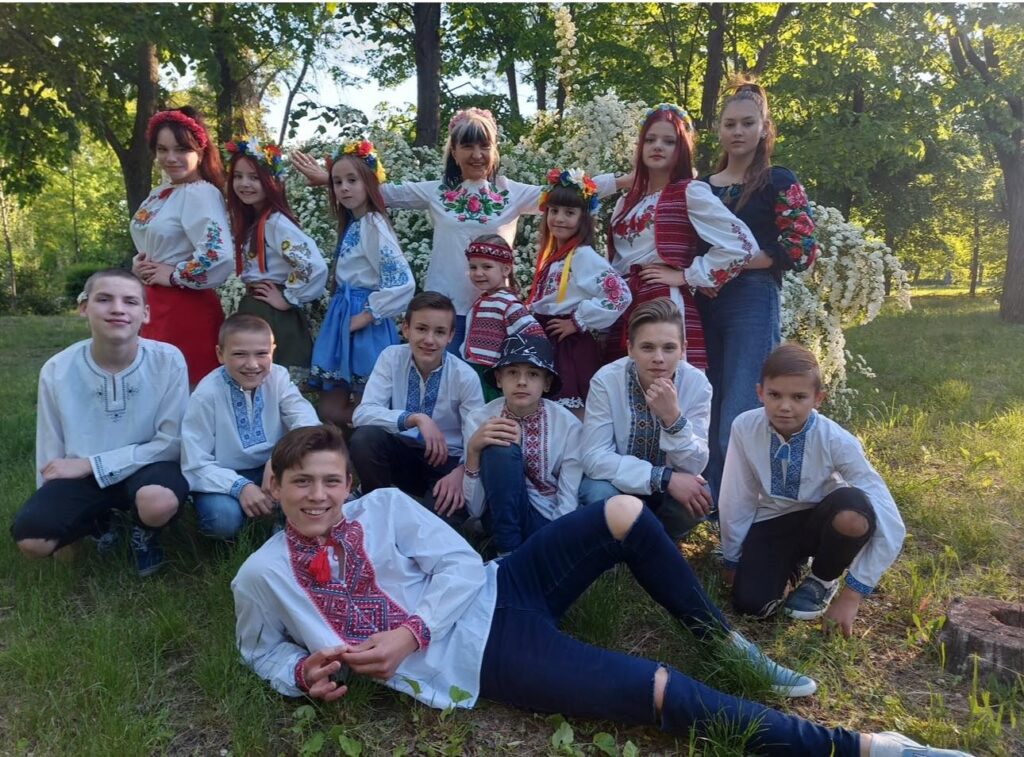
The family-type children’s home created by Valentyna and her husband will soon celebrate its 14th anniversary. Over the years, this home has become a family for 30 children, 20 of whom now live independently. Some are pursuing education, some are defending their country, and others have already blessed their foster parents with grandchildren.
Currently, the family cares for 12 children, facing challenges like many others during these difficult times.
When It All Began
At the start of the full-scale invasion, the family lived in the city of Marhanets, Dnipropetrovsk region. “It was a terrifying time,” Valentyna recalls. On the first day of the war, an explosion occurred near their home, leaving the children deeply frightened.
The family continued living in their home until August 2022. Each family member had an emergency bag ready, and the parents did their best to comfort the children. On August 12, taking only what they could carry, the family evacuated by train to Lviv and then to Yaremche. Finding shelter was difficult as no one wanted to rent to a family with so many children. Eventually, they found a place to stay.
Starting Anew
Adjusting to a new city was not easy for the children. After the trauma they had experienced, their emotional state was fragile, and some began to experience health issues. Even the youngest children in kindergarten initially felt unwelcome, as local kids hesitated to accept them due to their imperfect Ukrainian. However, the teachers worked tirelessly to support and assist them. Now, the younger children have adapted, while some of the older ones continue studying online through their school in Marhanets. This year, two girls graduated from high school and became students at Lviv universities
Used to hard work, the family continued to contribute to the community. Valentyna started working at Caritas, and the children helped daily by organizing items in the humanitarian warehouse and assisting elderly people. The local council also supported the family by providing food supplies.
The Greatest Treasure
The family’s home in Marhanets, where they lived before the war, was once a bank building. During the shelling, the safest place became the vault where the money had been stored. “When people asked the children where they hid during the shelling, they’d say, ‘In the money room.’ People were surprised and would ask, ‘Do you have that much money?’” Valentyna smiles. “But they were right—the children are our greatest treasure. And we’ll do everything to protect them.”
One Big Family
The love that Valentyna and her husband pour into their children multiplies and is passed on to others. One of their sons and his wife have also opened a family-type children’s home, just like the wife’s parents did. The three homes are closely connected, and before the full-scale war started, the children often spent time together. Shared celebrations, outdoor trips, and cultural events became moments of unity and joy for children.
Life Today
The family is accustomed to an active lifestyle. The children spend a lot of time outdoors and participate in various clubs and sports activities. The family has beautiful traditions that could inspire other parents. For example, each child’s birthday is a special occasion. The birthday child chooses the festive menu, and the children, led by their father, prepare the meal. Gifts are given at every step—literally. The birthday child comes down the stairs to the family, receiving a present on each step. One step, one gift.
Currently, the family lives in rented accommodation, awaiting a move to a new home in Ivano-Frankivsk provided by the government. However, for the move to happen, they need to furnish the house themselves. At the moment, there are no beds for the children or desks for studying.
“…Our hometown has been suffering from shelling for 2.5 years, but life goes on. The children are growing, and we must provide them with everything they need.”
Dad Oleksiy Brahynets
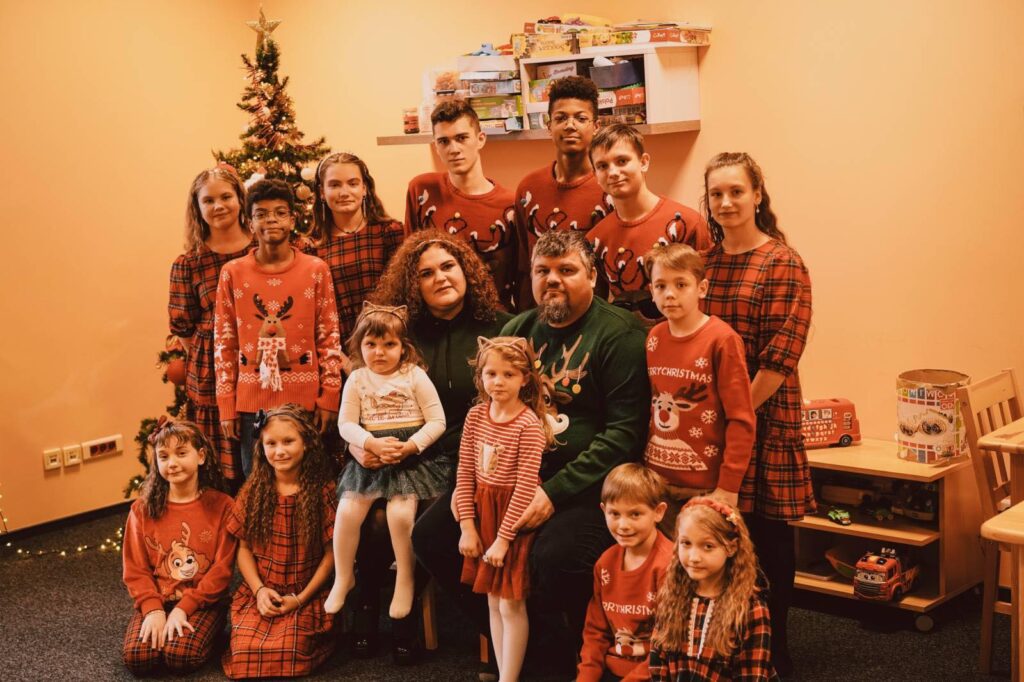
In the family of Oleksiy and Yelyzaveta, there are 14 children, all from orphanages. The first three boys were adopted in 2014, and a year later, the couple was approached by Child Services with an offer to adopt another boy. Now, the family has 14 children in their care.
Leaving their home
At the start of the russian invasion, the family lived in their large home in the Kyiv region. In the first days of the war, the roof of their house was damaged, and the family moved to Chernivtsi, and then to Poland. The children were eager to return home, where everything was familiar and comfortable.
“In Poland, we lived in a dormitory, but at home, we had a large yard and plenty of space for walks. Each child had a bicycle — 14 bicycles. In the summer, we could swim in the river, the street was impassable and safe.”
However, the guardianship services allowed the children to return home only on the condition that there would be a reliable shelter in the house. Oleksiy built a concrete shelter, lined it with wood on the inside, and installed a stove. Now, the children can stay there during shelling in more comfortable conditions. The children were happy to return home. They attend the school they are used to, and they feel at home. This is very important. Despite this, even at home, the children are not entirely safe today.
“Shaheds fly often. It can be at 5 in the morning or at night. Night alarms, shelling, and Shahed attacks — this is our reality today.”
The parents try to calm the children, distract them, and maintain a positive atmosphere despite everything.
We teach them to be children
The children who come to the family have serious emotional scars. Many of them have gone through such a difficult path that they prematurely became adults. Some have never felt maternal care and had to take care of younger siblings. Others have experienced violence. Oleksiy and Yelyzaveta teach each child to play, rejoice, and communicate. They help them feel like children again. The main association that a child should have with family is a sense of safety, and the couple understands this. That’s why the children develop such unusual attachment to their foster parents.
Before the war, they often traveled. They went to the sea and the Carpathians. Now, the children dream of traveling around their country again after the war ends and not fearing Shaheds. They also dream of simple childhood joys.
“My credo: By caring for the happiness of others, you find your own.”
In this family, there have been cases when a child, who was meant to be adopted by others, refused to leave the family. Oleksiy and Yelyzaveta adopted those children, realizing they had already become their own.
Dad Ruslan Voloshchuk
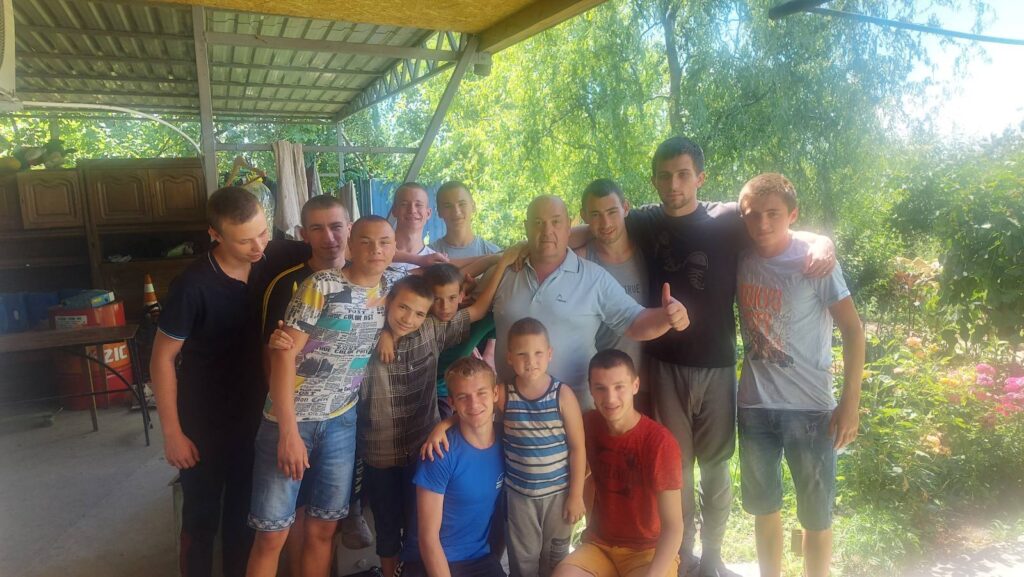
Ruslan is a unique person. After all, not every man dares to open a family-type children’s home and become the sole guardian for several children. And now, six boys, having grown up, have left the family and live independently. Another six remain in Ruslan’s care. Almost all the children have difficult lives: abandoned and traumatized by violence. But they have found a new family, love, and care.
“Life has been reset”
The war has ruined many lives, and Ruslan’s home was no exception. The family had to leave their native city, Beryslav in the Kherson region, and find a safer place for the children.
“The children dream of victory. At home, we left a lot of photos, almost all the walls were covered, and everything stayed there. Life has been reset, it is hard to live in someone else’s home, but we have children whom we need to teach, support, and help get through these difficult times.”
When the full-scale war started, a boy named Danylo had nowhere to go because the dormitory in Kherson was closed. Ruslan and his family took him in. The youngest, Mykyta, developed kidney problems after experiencing stress. During the occupation, they endured all the hardships together. Ruslan tells how they had to take in five more children who couldn’t return to their families because the occupiers blocked the road through the Hydroelectric Station. The children were taken from the dormitory, and there was no time to think. Now, the family is in the Odesa region. Their hometown is still being destroyed, but they have not lost hope.
“We really value each other, respect each other, and feel mutual support. We have to help the children preserve their mental health and ensure they survive this difficult period.”
Three older boys, raised by Ruslan, are now serving in the Ukrainian Armed Forces. The younger ones are studying and sincerely hope that the war will end, and they can return home. Although many of the children have grown up and live independently, on St. Nicholas Day and International Children’s Day (June 1), the whole family gathers around the dinner table. This is a tradition.
Children’s dreams should come true
Each child in the family has a cherished dream. The older children dream of getting an education and becoming independent. The youngest boy has an autoimmune disease and dreams of recovering. The family supports him as best they can and hopes that he will outgrow this illness — it is possible. “We dream of taking him to the sea when he overcomes his illness,” says Ruslan. Two other brothers in the family have disabilities, and unfortunately, these are incurable diseases. They will stay with their foster father forever.
Through the words of a child
Children may not be eloquent, but sometimes their words and actions speak louder than any speech. Ruslan recalls how a 12-year-old boy once said, “God placed me here.” This was the most valuable compliment for the father. Two other brothers, Sasha and Misha, call the day they joined the family their day of liberation. This event was a gift to the boys, as it happened the day after their birthday.
Dad Oleksiy Vasylychenko
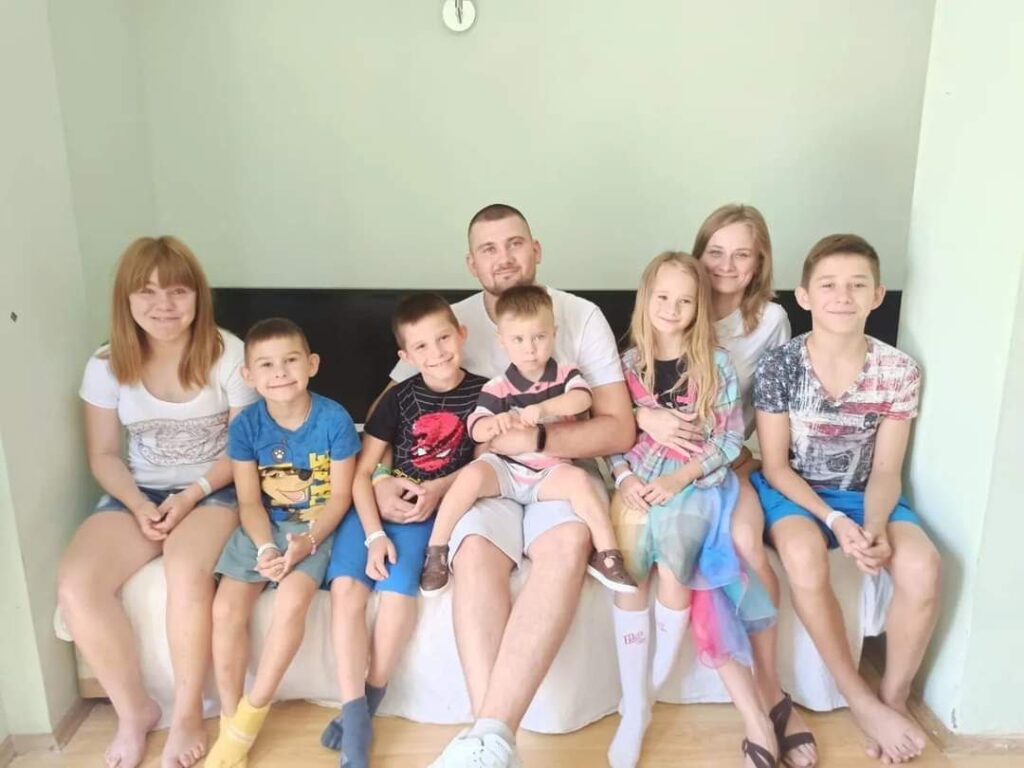
In 2006, Oleksiy’s mother created a family-type children’s home, and he grew up with his foster brothers and sisters. After becoming an adult and meeting his soulmate, Oleksiy shared his dream with his wife, who supported him. Thus, in mid-2021, the decision was made, and by March 2022, the paperwork was completed, and the newly established family became part of the “Childhood Without War” project. The family moved to Turkey.
At Home
The family returned home on September 2, 2024. Today, they are raising 5 foster children and 1 biological child. The family lives in a house where they hadn’t managed to settle before the war began. The war had a significant impact on the emotional state of both the children and the adults.
“Ukrainians have been forced to leave their homes, constantly changing places of residence, and our psychological and moral state was barely surviving… But we managed and returned home. As they say, there’s no place like home…”
When the family returned to their abandoned home, they were welcomed by two stray cats that had found refuge while the house was empty. Now, the cats have settled in, just like the dog — a beloved pet of the children. The children, as is typical for children, enjoy active games, riding bicycles, and sports activities. The oldest girl has developmental disabilities, so it’s hard to keep her engaged. However, even for her, simple tasks like helping around the house are found to be suitable.
Family Warmth
When the children first entered the family, they didn’t immediately open their hearts. The oldest, Danil, longed to grow up quickly and live independently. But with time, the parents’ patience and the warmth of the family paid off: the boy said he would like to always stay with his family. This happened right after their return to Ukraine from abroad.
The family warmth is especially felt in the house during the Christmas holidays. The Vasylychenko family decorates the house for New Year’s and Christmas every year, with the mother being a true artisan. Thus, Christmas and New Year’s are special family celebrations.
In the Frontline Zone
The house where the family lives is located near the combat zone, so nightly sirens have become a constant reality for the children. Leisure time also became a challenge — visits to relatives or trips to the city, which is under constant shelling, are impossible. After returning to Ukraine, the family didn’t have enough money to buy desks and writing tables for the children’s studies. This need was addressed by the Centersocial. However, the lack of electricity makes learning extremely difficult. The children are not only cut off from communication, making online education impossible, but the lack of electricity also causes water and heating to be cut off throughout the house, leaving the children cold. Thus, an urgent need has arisen to purchase a generator or an uninterrupted power supply system. A significant amount of money has already been invested in the house’s improvement, and the family is unable to afford a generator on their own.
Mom Olena Batskova
Olena grew up without parents and felt all the pain of being an orphan. As a teenager, she was taken in by a family that became her own. She gained parents, brothers, and sisters. Even back then, Olena made plans for the future, dreaming of creating a family-type children’s home, just like her mother, when she grew up.
In 2020 Olena’s foster mother fell seriously ill and soon passed away. At that time, the woman was raising 7 children, who were now orphaned for the second time. Something had to be done urgently. On one hand, the little ones had grown up under Olena’s watch, and she knew them well. On the other hand, this was a whole new and unfamiliar view of the children, whom she had always thought of as younger siblings.
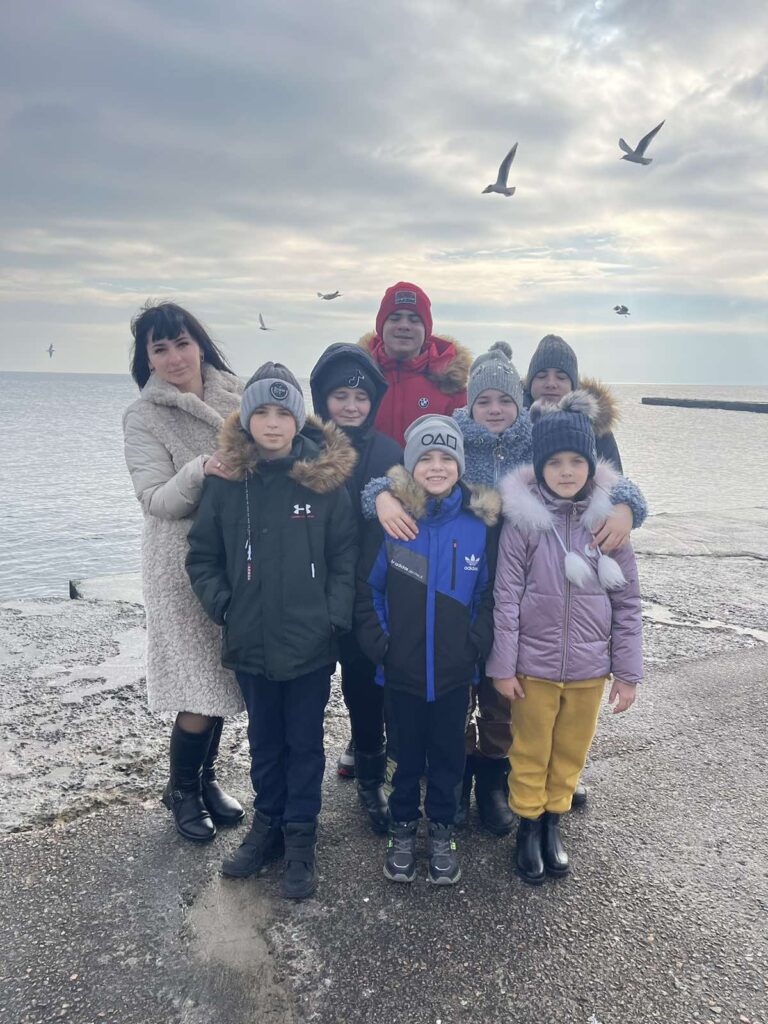
Initially, Olena was granted temporary guardian status, so for several months, she received no financial support. What would the future hold for the children? Could she handle such a load? Would the family budget withstand it? These thoughts were frightening. However, the sincere trust of the children became an unexpected source of support, and Olena managed to cope. Thus, Olena and her husband became the parents of seven foster children, who are now raised in the family alongside their biological child.
Without a Home
Before the full-scale war started, the family lived in the city of Oleshky, Kherson region. By March 2022, the children and their guardians had to endure the horrors of occupation, then leave their home and move to a safer place. Currently, the family lives in Pereiaslav, Mykolaiv region, starting a new life from scratch. Their previous life is now in the past: school, friends, neighbors, the house, and everything that was in it.
The father joined the Armed Forces of Ukraine, and Olena stayed with the children. The family currently has no home and lives in a nursing home.
“We really need separate housing. The children would like to invite guests, and bring friends over after school, but right now, we can’t afford that.”
The family is waiting for the provision of municipal housing. The Centersocial has gifted the family beds for their new home. The children are already dreaming of separate rooms and a spacious living room. Their mother believes that the future will bring good changes.
Who Are These Children?
The children in this family are not ordinary. Among them, there are two boys with the diagnosis F70 (mild intellectual disability) and one with F71 (moderate intellectual disability). Even in peaceful times, raising children with special needs is a challenging task. The war has greatly amplified all the difficulties. One of the current important needs for the family is the purchase of a laptop for the oldest boy, on which he could study and master computer programs. He dreams of a career in the IT field. The boy is also passionate about sports and plays volleyball. However, the greatest need the family currently feels is for housing and its interior arrangement.
Father Maksym Kryvko
Maksym was inspired by his parents, who have been providing family warmth to children left without parental care for over 10 years. After starting his own family, Maksym shared his dream with his wife, who supported him. They initially created a foster family and in 2023 welcomed a group of four siblings. This year, they officially established a family-type children’s home, taking in three more children. Later, a boy joined them temporarily as his mother had passed away and his father is serving in the Armed Forces of Ukraine.
Today, the family cares for eight children.
During the War
Running a family-type children’s home during wartime is extremely challenging, Maksym admits. Although the family now resides in the Lviv region, the frequent air raid alerts, time spent in shelters, and occasional nearby explosions are physically and emotionally draining.
“During the war, it’s very hard, and you never know the future. But there are children who long to have a father and mother. And we want them to feel safe and to give them what they dream of most—a family and love.”
The children, already traumatized, experience constant stress due to the war. The adults do their best to comfort them, and the family prays together for peace to come.
Each child who comes to a family-type children’s home carries their challenges. These are children who have suffered abuse, neglect, or abandonment. Some have been beaten by their parents, others forced to scavenge through garbage, and some have even faced life-threatening situations. Working with such children requires not only parenting but also psychological support, often in collaboration with professional therapists.
“Thank You for the Hugs!”
The children, in turn, bring joy and warmth to their parents. One day, they decided to surprise Maksym and his wife with a bright poster. It featured drawings of their parents surrounded by painted handprints of the children. Each child wrote what they were grateful for: “Thank you for the hugs, kisses, love, care, and warmth! Our parents are the best!” The poster still decorates the family’s home, a reminder of their mutual love and appreciation.
Urgent Need
A large family means buying and stocking food in bulk to manage expenses effectively. Currently, Maksym’s family urgently needs a large freezer to store food supplies, especially given the risks of spoilage during power outages.
Foster Families: Building Ukraine’s Future
In these challenging times of war, supporting family-type children’s homes is more crucial than ever. These families have become a reliable haven for children in need of love and care, despite the hardships they face. They provide an environment closely resembling that of traditional families, helping children grow and prepare for independent life in society.
According to the Ministry of Social Policy, as of May 2024, Ukraine had 1,300 family-type children’s homes caring for over 9,000 children. These families are a testament to humanity, compassion, and resilience.
For nearly two years, our organization has been assisting such families. During this time, 77 families have received support. Many of them have been displaced due to the war, lost their homes in occupied territories, or are raising children with special needs. Some of these families were formed during the full-scale war, showcasing remarkable courage and dedication.
Supporting family-type children’s homes is not just about providing immediate assistance—it’s an investment in Ukraine’s future. Together, we can help these families create warm and safe environments for the children they nurture. Now, more than ever, these families need our support.